
Internet Radio Hosting Plans Explained
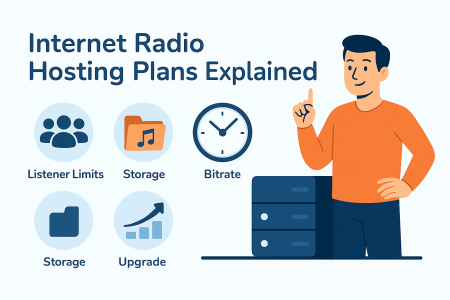
Internet radio hosting plans come in different sizes depending on your audience, audio quality needs, and how much automation you want to run through AutoDJ. This guide explains what each part of a hosting plan means so you can choose the right option for your station.
Key Takeaways
- Internet radio hosting plans vary by listener limits, bitrate, AutoDJ storage, bandwidth usage, and support features.
- Choose a listener limit based on your audience size, with options from 25 to over 250 listeners.
- Select the appropriate bitrate: 128 kbps is standard for music, while 64 kbps works for talk radio.
- AutoDJ storage impacts how many songs you can upload; options typically range from 1 GB to over 10 GB.
- Starting with a smaller plan is advisable; you can upgrade as your station’s needs grow.
Listener Limits Explained
A listener limit tells you how many people can tune in at the same time. For example, a plan with 50 listeners allows 50 concurrent connections. When the limit is reached, new listeners will not be able to connect until someone leaves the stream.
Common listener limit levels include:
- 25 listeners, ideal for small community stations
- 50 listeners, good for growing stations
- 100 listeners, suitable for consistent daily traffic
- 250 listeners and above, used by established broadcasters
Choose a listener limit based on your current audience size. You can always upgrade as your station grows.
Bitrate and Audio Quality
The bitrate determines the audio quality of your stream. Higher bitrates give better sound but use more bandwidth. Most hosting plans let you pick one bitrate setting for your stream.
- 64 kbps, best for talk radio or low bandwidth streams
- 96 kbps, an improvement for mixed content
- 128 kbps, the most popular bitrate for music stations
- 192 kbps or higher, premium audio quality for music-heavy stations
If your station plays music, 128 kbps is the most common choice. Talk-only stations can use lower bitrates without losing quality.
AutoDJ Storage
AutoDJ storage determines how many songs you can upload to your hosting control panel. This is important if you want your station to stay online when you are not broadcasting live.
Typical AutoDJ storage options include:
- 1 GB, basic playlist rotation
- 2 GB, small collection with multiple playlists
- 5 GB, large collection, and scheduled shows
- 10 GB and above, ideal for music-heavy stations
More storage means more songs, more playlists, and more scheduling flexibility.
Bandwidth Usage
Bandwidth is the amount of data your stream uses when listeners tune in. Most hosting plans include enough bandwidth for typical station usage without extra charges.
The amount of bandwidth you use depends on:
- Your bitrate
- Your listener limit
- How many hours do people listen per day
If your station has long listening sessions or a large audience, choose a plan with generous bandwidth to avoid limitations.
Support and Reliability
Higher-tier hosting plans often include improved performance features such as:
- Better uptime
- Faster server response
- More stable streaming under heavy listener load
Even small stations benefit from reliable server performance, especially if your listeners are tuning in from different countries or mobile devices.
Which Plan Is Right for You
The best plan depends on your content style and expected audience.
- Small stations, choose 25 or 50 listener plans with 64 to 96 kbps
- Growing stations, choose 100 listener plans with 128 kbps
- Music stations, choose higher bitrates and larger AutoDJ storage
- Talk stations, choose lower bitrates and modest storage
Starting with a smaller plan is fine, since you can upgrade as your listener base increases.
Related Guides
- Complete Guide to Internet Radio Hosting
- How to Set Up an Internet Radio Station
- Improving Your Station Content
FAQs
Listener limits determine how many people can tune in at the same time. When the limit is reached, new listeners will not be able to connect until a slot becomes available.
For music, 128 kbps is the most common choice. Talk radio can use 64 kbps without losing quality. Higher bitrates offer better audio but use more bandwidth.
Small stations can start with 1 to 2 GB. Music-heavy stations benefit from 5 to 10 GB or more, so they can keep multiple playlists and schedules active.
Yes, higher bitrates use more bandwidth per listener. If you expect long listening sessions or a large audience, choose a plan with generous bandwidth.
Yes, most internet radio hosting platforms let you upgrade at any time. Starting with a smaller plan is fine, and you can increase capacity as your audience grows.


